Skip to content

Jessup, Howard Lee
Army Private 1st class

Howard Lee Jessup, age 20, from Ohio, Summit county.

Service era: Korea

Date of death: Monday, December 4, 1950
Death details: On the evening of November 27, 1950, Chinese Communist Forces (CCF) launched a massive attack against the U.S. and United Nations (UN) troops stationed in the Chosin Reservoir area in north-east North Korea. The resulting seventeen-day conflict became known as the Battle of Chosin Reservoir. At the time of the initial CCF attack, members of the U.S. Army’s 31st and 32nd Infantry Regiments were defending the area north of Sinhung-ni, on the east side of the reservoir. The defenders were overwhelmed by the numerically superior CCF, and on December 1 were forced to withdraw to friendly lines at Hagaru-ri. Many men were lost or captured during the withdraw, with survivors reaching friendly lines in Hagaru-ri on December 2 and 3. Once at Hagaru-ri, the survivors of the withdrawal manned a section of the perimeter near East Hill, a strong defensive position overlooking the town. On the night of December 3, the Chinese attacked the Hagaru-ri perimeter and overwhelmed the defenders there. Many Americans were killed or went missing during these actions. Corporal Howard Lee Jessup, who joined the U.S. Army from Ohio, was a member of I Company, 3rd Battalion, 31st Infantry Regiment, 7th Infantry Division. On December 3, he was captured by the CCF during the fighting withdrawal to Hagaru-ri. He died soon after his capture on December 4, as the result of wounds he suffered during the fighting. He was reportedly buried in the Chosin Reservoir area, and he has not been identified among remains returned to U.S. custody following the end of hostilities. Today, Corporal Jessup is memorialized on the Courts of the Missing at the National Memorial Cemetery of the Pacific.

Source: National Archives, Defense POW/MIA Accounting Agency

Dorser, Jimmie Leonard
Army Private 1st class

Jimmie Leonard Dorser, age 17, from Missouri, Greene county.

Service era: Korea

Date of death: Sunday, December 3, 1950
Death details: On December 13, 2006, the Joint POW/MIA Accounting Command (JPAC, now DPAA) identified the remains of Corporal Jimmie Leonard Dorser, missing from the Korean War. Corporal Dorser joined the U.S. Army from Missouri and was a member of I Company, 3rd Battalion, 31st Infantry Regiment, 7th Infantry Division. In late November 1950, his unit was positioned east of the Chosin Reservoir in North Korea. On November 27, Chinese Communist Forces launched a large-scale surprise attack against U.S. forces in the vicinity of the Chosin Reservoir, forcing a southward withdrawal. CPL Dorser was lost during the fighting withdrawal from Chosin. His remains could not be recovered at the time of his loss, and he was not identified among remains returned to U.S. custody immediately after the ceasefire. In 2002, a joint U.S. and North Korean investigative team excavated a mass grave on the eastern side of the Chosin Reservoir. Analysts were eventually able to identify CPL Dorser from among these remains. Corporal Dorser is memorialized on the Courts of the Missing at the National Memorial Cemetery of the Pacific.

Source: National Archives, Defense POW/MIA Accounting Agency
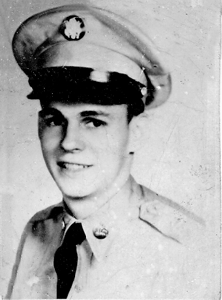
Mathis, Grayson Lee
Army Private

Grayson Lee Mathis, age 19, from Maryland, Montgomery county.

Service era: Korea

Date of death: Sunday, December 3, 1950
Death details: On the evening of November 27, 1950, Chinese Communist Forces (CCF) launched a massive attack against the U.S. and United Nations (UN) troops stationed in the Chosin Reservoir area in north-east North Korea. The resulting seventeen-day conflict became known as the Battle of Chosin Reservoir. At the time of the initial CCF attack, members of the U.S. Army’s 31st and 32nd Infantry Regiments were defending the area north of Sinhung-ni, on the east side of the reservoir. The defenders were overwhelmed by the numerically superior CCF, and on December 1 were forced to withdraw to friendly lines at Hagaru-ri. Many men were lost or captured during the withdraw, with survivors reaching friendly lines in Hagaru-ri on December 2 and 3. Once at Hagaru-ri, the survivors of the withdrawal manned a section of the perimeter near East Hill, a strong defensive position overlooking the town. On the night of December 3, the Chinese attacked the Hagaru-ri perimeter and overwhelmed the defenders there. Many Americans were killed or went missing during these actions. Sergeant Grayson Lee Mathis, who joined the U.S. Army from Maryland, served with I Company, 3rd Battalion, 31st Infantry Regiment, 7th Infantry Division. His unit was part of the 31st Regimental Combat Team (RCT), which arrived at the Chosin Reservoir in late November, 1950. Sergeant Mathis was reported missing in action on December 3, near Hagaru-ri, when the CCF attacked the defensive perimeter the 31st had established on the east side of the town. The details surrounding his disappearance are unknown; he was seen to fall in battle, and he was not reported to be a prisoner of war. When the 31st RCT withdrew to the port of Hamhung for evacuation, they were unable to take the bodies of the fallen with them. Sgt. Mathis’s remains were not identified among those returned to U.S. custody after the war. Today, Sergeant Mathis is memorialized on the Courts of the Missing at the National Memorial Cemetery of the Pacific.

Source: National Archives, Defense POW/MIA Accounting Agency

Andrews, Leon Eugene
Army Corporal

Leon Eugene Andrews, age 24, from Brewer, Maine, Penobscot county.

Service era: Korea

Date of death: Sunday, December 3, 1950
Death details: On the evening of November 27, 1950, Chinese Communist Forces (CCF) launched a massive attack against the U.S. and United Nations (UN) troops stationed in the Chosin Reservoir area in north-east North Korea. The resulting seventeen-day conflict became known as the Battle of Chosin Reservoir. At the time of the initial CCF attack, members of the U.S. Army’s 31st and 32nd Infantry Regiments were defending the area north of Sinhung-ni, on the east side of the reservoir. The defenders were overwhelmed by the numerically superior CCF, and on December 1 were forced to withdraw to friendly lines at Hagaru-ri. Many men were lost or captured during the withdraw, with survivors reaching friendly lines in Hagaru-ri on December 2 and 3. Once at Hagaru-ri, the survivors of the withdrawal manned a section of the perimeter near East Hill, a strong defensive position overlooking the town. On the night of December 3, the Chinese attacked the Hagaru-ri perimeter and overwhelmed the defenders there. Many Americans were killed or went missing during these actions. Corporal Leon Eugene Andrews entered the U.S. Army from Maine and served with F Company, 2nd Battalion, 31st Infantry Regiment, 7th Infantry Division. On December 3, 1950, he was killed in action during the combat near East Hill, though specific details surrounding his death are unknown. Following his loss, CPL Andrews was buried at Koto-ri Cemetery; however, his remains have not been identified among those returned to U.S. custody after the war. He remains unaccounted for. Today, Corporal Andrews is memorialized on the Courts of the Missing at the National Memorial Cemetery of the Pacific.

Source: National Archives, Defense POW/MIA Accounting Agency, Portland Press Herald (1951)

Drew, Kenneth Henry
Army Private 1st Class

Kenneth Henry Drew, age 28, from Massachusetts, Hampshire county.

Service era: Korea

Date of death: Sunday, December 3, 1950
Death details: On the evening of November 27, 1950, Chinese Communist Forces (CCF) launched a massive attack against the U.S. and United Nations (UN) troops stationed in the Chosin Reservoir area in north-east North Korea. The resulting seventeen-day conflict became known as the Battle of Chosin Reservoir. At the time of the initial CCF attack, members of the U.S. Army’s 31st and 32nd Infantry Regiments were defending the area north of Sinhung-ni, on the east side of the reservoir. The defenders were overwhelmed by the numerically superior CCF, and on December 1 were forced to withdraw to friendly lines at Hagaru-ri. Many men were lost or captured during the withdraw, with survivors reaching friendly lines in Hagaru-ri on December 2 and 3. Once at Hagaru-ri, the survivors of the withdrawal manned a section of the perimeter near East Hill, a strong defensive position overlooking the town. On the night of December 3, the Chinese attacked the Hagaru-ri perimeter and overwhelmed the defenders there. Many Americans were killed or went missing during these actions. Corporal Kenneth Henry Drew, who joined the U.S. Army from Massachusetts, was a member of I Company, 3rd Battalion, 31st Infantry Regiment, 7th Infantry Division. He was reported missing in action on December 3, 1950, shortly after the fighting withdrawal from the Chosin Reservoir area. He was never reported as a prisoner of war, and he remains unaccounted for following his loss. Today, Corporal Drew is memorialized on the Courts of the Missing at the National Memorial Cemetery of the Pacific.

Source: National Archives, Defense POW/MIA Accounting Agency

Beaty, Charles Edwin
Army Corporal

Charles Edwin Beaty, age 26, from Arkansas, Craighead county.

Parents: Eva Howard

Service era: Korea

Date of death: Sunday, December 3, 1950
Death details: On the evening of November 27, 1950, Chinese Communist Forces (CCF) launched a massive attack against the U.S. and United Nations (UN) troops stationed in the Chosin Reservoir area in north-east North Korea. The resulting seventeen-day conflict became known as the Battle of Chosin Reservoir. At the time of the initial CCF attack, members of the U.S. Army’s 31st and 32nd Infantry Regiments were defending the area north of Sinhung-ni, on the east side of the reservoir. The defenders were overwhelmed by the numerically superior CCF, and on December 1 were forced to withdraw to friendly lines at Hagaru-ri. Many men were lost or captured during the withdraw, with survivors reaching friendly lines in Hagaru-ri on December 2 and 3. Once at Hagaru-ri, the survivors of the withdrawal manned a section of the perimeter near East Hill, a strong defensive position overlooking the town. On the night of December 3, the Chinese attacked the Hagaru-ri perimeter and overwhelmed the defenders there. Many Americans were killed or went missing during these actions. Sergeant Charles Edwin Beaty entered the U.S. Army from Arkansas and was a member of I Company, 3rd Battalion, 31st Infantry Regiment, 7th Infantry Division. On December 3, 1950, he went missing in action near Hagaru-ri, though specific details surrounding his loss are unknown. His remains have not been identified among those returned to U.S. custody after the ceasefire, and he is still unaccounted-for. Today, Sergeant Beaty is memorialized on the Courts of the Missing at the National Memorial Cemetery of the Pacific.

Source: National Archives, Defense POW/MIA Accounting Agency, Wilmington Daily Press Journal (1951)

Durfee, Lamont J.
Army Sergeant 1st class

Lamont J. Durfee, age 30, from Michigan, Mason county.

Service era: Korea

Date of death: Sunday, December 3, 1950
Death details: On the evening of November 27, 1950, Chinese Communist Forces (CCF) launched a massive attack against the U.S. and United Nations (UN) troops stationed in the Chosin Reservoir area in north-east North Korea. The resulting seventeen-day conflict became known as the Battle of Chosin Reservoir. At the time of the initial CCF attack, members of the U.S. Army’s 31st and 32nd Infantry Regiments were defending the area north of Sinhung-ni, on the east side of the reservoir. The defenders were overwhelmed by the numerically superior CCF, and on December 1 were forced to withdraw to friendly lines at Hagaru-ri. Many men were lost or captured during the withdraw, with survivors reaching friendly lines in Hagaru-ri on December 2 and 3. Once at Hagaru-ri, the survivors of the withdrawal manned a section of the perimeter near East Hill, a strong defensive position overlooking the town. On the night of December 3, the Chinese attacked the Hagaru-ri perimeter and overwhelmed the defenders there. Many Americans were killed or went missing during these actions. Master Sergeant Lamont J. Durfee, who joined the U.S. Army from Arizona, served with I Company, 3rd Battalion, 31st Infantry Regiment, 7th Infantry Division. He went missing in action on December 3, 1950, during the CCF attack, though specific details regarding his loss are unknown. No one saw him fall, and he was never reported to be a prisoner of war. After the war, his remains were not identified among those returned to U.S. custody. Today, Master Sergeant Durfee is memorialized on the Courts of the Missing at the National Memorial Cemetery of the Pacific.

Source: National Archives, Defense POW/MIA Accounting Agency

Nelson, Charles Tobias
Army Corporal

Charles Tobias Nelson, age 21, from Michigan, Kent county.

Service era: Korea

Date of death: Sunday, December 3, 1950
Death details: On the evening of November 27, 1950, Chinese Communist Forces (CCF) launched a massive attack against the U.S. and United Nations (UN) troops stationed in the Chosin Reservoir area in north-east North Korea. The resulting seventeen-day conflict became known as the Battle of Chosin Reservoir. At the time of the initial CCF attack, members of the U.S. Army’s 31st and 32nd Infantry Regiments were defending the area north of Sinhung-ni, on the east side of the reservoir. The defenders were overwhelmed by the numerically superior CCF, and on December 1 were forced to withdraw to friendly lines at Hagaru-ri. Many men were lost or captured during the withdraw, with survivors reaching friendly lines in Hagaru-ri on December 2 and 3. Once at Hagaru-ri, the survivors of the withdrawal manned a section of the perimeter near East Hill, a strong defensive position overlooking the town. On the night of December 3, the Chinese attacked the Hagaru-ri perimeter and overwhelmed the defenders there. Many Americans were killed or went missing during these actions. Sergeant Charles Tobias Nelson entered the U.S. Army from Michigan and served with I Company, 3rd Battalion, 31st Infantry Regiment, 7th Infantry Division. On December 3, he went missing in action during the combat at Hagaru-ri near East Hill, though specific details regarding his loss are unknown. His remains have not been identified among any of those later returned to U.S. custody, and he remains unaccounted for. Today, Sergeant Nelson is memorialized on the Courts of the Missing at the National Memorial Cemetery of the Pacific.

Source: National Archives, Defense POW/MIA Accounting Agency

Block, Kenneth Roy
Army Corporal

Kenneth Roy Block, age 22, from Birmingham, Michigan, Oakland county.

Service era: Korea

Date of death: Sunday, December 3, 1950
Death details: On May 18, 2012, the Joint POW/MIA Accounting Command (JPAC, now DPAA) identified the remains of MSG Corporal Kenneth Roy Block, missing from the Korean War. Corporal Block entered the U.S. Army from Michigan and served in M Company, 3rd Battalion, 31st Infantry Regiment, 7th Infantry Division. On December 3, 1950, he was killed by Chinese Communist Forces during his unit’s withdrawal to the village of Hagaru-ri, North Korea. He was buried near the area of his loss, but his remains were not returned to the U.S. immediately following the war. In 2001 a joint U.S./ North Korean investigative team recovered the remains of several U.S. soldiers from a mass grave site near the Chosin Reservoir. In 2012, analysts were able to successfully identify CPL Block from among these remains. Corporal Block is memorialized on the Courts of the Missing at the National Memorial Cemetery of the Pacific.

Source: National Archives, Defense POW/MIA Accounting Agency, Lansing State Journal (1951)

Gruebbeling, Walter Herman
Army Sergeant

Walter Herman Gruebbeling, age 35, from Minnesota, Douglas county.

Service era: Korea

Date of death: Sunday, December 3, 1950
Death details: On the evening of November 27, 1950, Chinese Communist Forces (CCF) launched a massive attack against the U.S. and United Nations (UN) troops stationed in the Chosin Reservoir area in north-east North Korea. The resulting seventeen-day conflict became known as the Battle of Chosin Reservoir. At the time of the initial CCF attack, members of the U.S. Army’s 31st and 32nd Infantry Regiments were defending the area north of Sinhung-ni, on the east side of the reservoir. The defenders were overwhelmed by the numerically superior CCF, and on December 1 were forced to withdraw to friendly lines at Hagaru-ri. Many men were lost or captured during the withdraw, with survivors reaching friendly lines in Hagaru-ri on December 2 and 3. Once at Hagaru-ri, the survivors of the withdrawal manned a section of the perimeter near East Hill, a strong defensive position overlooking the town. On the night of December 3, the Chinese attacked the Hagaru-ri perimeter and overwhelmed the defenders there. Many Americans were killed or went missing during these actions. Sergeant First Class Walter Herman Gruebbeling, who joined the U.S. Army from Minnesota, served with I Company, 3rd Battalion, 31st Infantry Regiment, 7th Infantry Division. He went missing in action on December 3, 1950, as the CCF attacked U.S. defensive lines around Hagaru-ri. No one saw him fall during the battle, and he was not reported to be a prisoner of war. After the war, his remains were not identified among those returned to U.S. custody. Today, Sergeant First Class Gruebbeling is memorialized on the Courts of the Missing at the National Memorial Cemetery of the Pacific.

Source: National Archives, Defense POW/MIA Accounting Agency

Back To Top