Skip to content

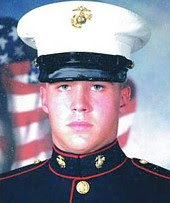
Bishop, Jeffrey Adam
Marines Lance corporal

Jeffrey Adam Bishop, age 23, from Dickson, Tennessee, Dickson county.

Service era: Iraq
Military history: Wpns Co, 3D Bn, 6Th Mar, (Rct-6, Ii Mef Fwd), 2D Mar Div, Camp Lejeune, North Carolina

Date of death: Friday, April 20, 2007
Death details: Hostile; Al Taqaddum, Iraq

Source: Department of Defense

Harris, Kenneth Wayne Jr
Army Sergeant

Kenneth Wayne Jr Harris, age 23, from Charlotte, Tennessee, Dickson county.

Service era: Iraq
Military history: 212Th Transportation Company, Heavy Truck, Chattanooga, Tn 37421

Date of death: Wednesday, August 20, 2003
Death details: Scania, Iraq

Source: Department of Defense, Military Times

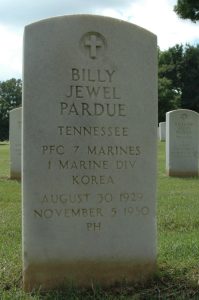
Pardue, Billy Jewel
Marines Private 1st class

Billy Jewel Pardue, age 21, from Charlotte, Tennessee, Dickson county.

Service era: Korea
Military history: 7 Marines, 1st Marine Division; Purple Heart

Date of death: Sunday, November 5, 1950
Cemetery: Nashville National

Source: National Archives, grave marker

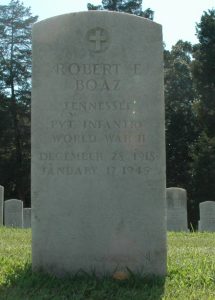
Boaz, Robert E.
Army Private

Robert E. Boaz, age 26, from Tennessee, Dickson county.

Service era: World War II
Military history: Infantry

Date of death: Wednesday, January 17, 1945
Death details: Died of wounds
Cemetery: Fort Donelson National

Source: National Archives, grave marker

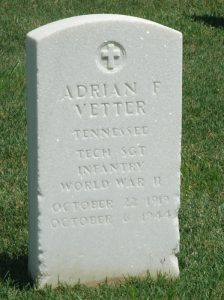
Vetter, Adrian F.
Army Technician sergeant

Adrian F. Vetter, age 24, from Tennessee, Dickson county.

Service era: World War II
Military history: Infantry

Date of death: Friday, October 6, 1944
Death details: Killed in action
Cemetery: Nashville National

Source: National Archives, grave marker

Larkins, John M.
Army Technician sergeant

John M. Larkins, age 26, from Dickson County Tennessee.

Service era: World War II

Date of death: Tuesday, June 27, 1944
Death details: On June 13, 2025, the Defense POW/MIA Accounting Agency (DPAA) identified the remains of Tech. Sgt. John M. Larkins, missing from World War II. Larkins entered the U.S. Army Air Forces from Tennesse and served with the 678th Bombardment Squadron, 444th Bombardment Group. On June 27, 1944, he was the navigator aboard a B-29 Superfortress (serial number 42-6323) carrying eleven crew members on a bombing raid against enemy installations on Kyushu Island, Japan. After completing its mission, the aircraft crashed into a flooded rice paddy field while flying over Sapekhati, India, killing all those aboard and scattering debris for hundreds of yards. Following the crash, members of the 342nd Service Squadron, 329th Service Group visited the crash site and identified the remains of seven crew members. The other four crew members, including Larkins, were declared non-recoverable by the American Graves Registration Command in a 1948 review. In October 2014 the Joint POW/MIA Accounting Command (a DPAA predecessor organization) conducted a Joint Field Activity in Sapekhati which led to the location of the crash site and the recovery of equipment and wreckage associated with the B-29 aircraft. In 2018 and 2019, Southeastern Archaeological Research (SEARCH), a DPAA partner organization, excavated the site and recovered osseous remains and material evidence. These remains and material evidence were later consolidated by the DPAA laboratory for further study. The laboratory forensic analysis and the total material and historical evidence available established an association between one portion of these remains and Larkins.

Source: National Archives, Defense POW/MIA Accounting Agency, Nashville Banner (1944)
Sensing, Robert A.
Army Sergeant

Robert A. Sensing from Tennessee, Dickson county.

Service era: World War II

Date of death: Wednesday, August 12, 1942
Death details: Following the Allied surrender on the Bataan Peninsula on April 9, 1942, the Japanese began the forcible transfer of American and Filipino prisoners of war to various prison camps in central Luzon, at the northern end of the Philippines. The largest of these camps was the notorious Cabanatuan Prison Camp. At its peak, Cabanatuan held approximately 8,000 American and Filipino prisoners of war that were captured during and after the Fall of Bataan. Camp overcrowding worsened with the arrival of Allied prisoners who had surrendered from Corregidor on May 6, 1942. Conditions at the camp were poor, with food and water extremely limited, leading to widespread malnutrition and outbreaks of malaria and dysentery. By the time the camp was liberated in early 1945, approximately 2,800 Americans had died at Cabanatuan. Prisoners were forced to bury the dead in makeshift communal graves, often completed without records or markers. As a result, identifying and recovering remains interred at Cabanatuan was difficult in the years after the war. Sergeant Robert A. Sensing entered the U.S. Army Air Forces from Tennessee and served with the 48th Bombardment Squadron, 27th Bombardment Group in the Philippines during World War II. He was captured in Bataan following the American surrender on April 9, 1942, and died of dysentery and malaria on August 12, 1942, at the Cabanatuan Prison Camp in Nueva Ecija Province. He was buried in a communal grave in the camp cemetery along with other deceased American POWs; however, his remains could not be associated with any remains recovered from Cabanatuan after the war. Today, Sergeant Sensing is memorialized on the Walls of the Missing at the Manila American Cemetery in the Philippines.

Source: National Archives, Defense POW/MIA Accounting Agency

Field, Thomas C.
Private

Thomas C. Field from Tennessee, Dickson county.

Service era: World War I

Date of death: Unknown
Death details: Killed in action

Source: Soldiers of the Great War, findagrave.com, findagrave.com

Back To Top