Skip to content

Rhodes, Roy Daniel
Army Private 1st class
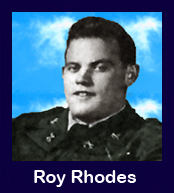
Roy Daniel Rhodes, age 20, from Missouri, Madison county.

Parents: Floyd and Sarah Rhodes

Service era: Korea
Military history: 35th Infantry Regiment

Date of death: Saturday, July 22, 1950
Death details:  On July 22, 1950, the 2nd Battalion of the U.S. Army’s 35th Infantry Regiment was holding defensive positions along the south bank of the rain-swollen Yong stream, south of Mun’gyong, South Korea. The battalion’s Company F was sent across the stream to reinforce a Republic of Korea (ROK) battalion on the north bank, but the ROK-U.S. position was immediately attacked by North Korean People’s Army (NKPA) forces, separating them from the rest of the 2nd Battalion and flanking Company F on both sides. Company F fell back to the stream’s edge under enemy fire, but the current was too powerful for them to cross and the enemy had seized the nearby bridge. U.S. combat engineers on the south bank attempted to launch rafts for the stranded men but were also pinned down by the NKPA until additional American tanks and infantry arrived to give them covering fire. This enabled the engineers to deploy their rafts and evacuate the men of Company F from the north bank. However, several soldiers were lost to enemy fire or while attempting to cross the swollen stream before the rafts could be launched.

Corporal Roy Daniel Rhodes, who entered the U.S. Army from Missouri, served with F Company, 2nd Battalion, 35th Infantry Regiment, 25th Infantry Division. He went missing while attempting to cross the Yong stream during this action on July 22, 1950. He was not associated with any remains later recovered from the area, and he is still unaccounted-for. Today, Corporal Rhodes is memorialized on the Courts of the Missing at the National Memorial Cemetery of the Pacific.

Source: 35th Infantry Regiment Association, Defense POW/MIA Accounting Agency

Clark, Charles E.
Army Private

Charles E. Clark, age 28, from Roselle, Missouri, Madison county.

Parents: Walter Clark

Service era: World War II

Date of death: Wednesday, September 30, 1942
Death details: Following the Allied surrender on the Bataan Peninsula on April 9, 1942, the Japanese began the forcible transfer of American and Filipino prisoners of war to various prison camps in central Luzon, at the northern end of the Philippines. The largest of these camps was the notorious Cabanatuan Prison Camp. At its peak, Cabanatuan held approximately 8,000 American and Filipino prisoners of war that were captured during and after the Fall of Bataan. Camp overcrowding worsened with the arrival of Allied prisoners who had surrendered from Corregidor on May 6, 1942. Conditions at the camp were poor, with food and water extremely limited, leading to widespread malnutrition and outbreaks of malaria and dysentery. By the time the camp was liberated in early 1945, approximately 2,800 Americans had died at Cabanatuan. Prisoners were forced to bury the dead in makeshift communal graves, often completed without records or markers. As a result, identifying and recovering remains interred at Cabanatuan was difficult in the years after the war. Private Charles E. Clark joined the U.S. Army from Missouri and served with Company H of the 515th Coast Artillery Regiment in the Philippines during World War II. He was captured in Bataan following the American surrender and died of malaria on September 30, 1942, at the Cabanatuan Prison Camp in Nueva Ecija Province. He was buried in a communal grave in the camp cemetery along with other deceased American POWs; however, his remains could not be associated with any remains recovered from Cabanatuan after the war. Today, Private Clark is memorialized on the Walls of the Missing at the Manila American Cemetery in the Philippines.

Source: Defense POW/MIA Accounting Agency, Democrat News (1943)

Back To Top