Skip to content

Gardner, James Wilkerson
Army Specialist

James Wilkerson Gardner, age 22, from Glasgow, Kentucky, Barren county.

Service era: Iraq
Military history: Company B, 1St Battalion, 101St Aviation, Avn Bde, Fort Campbell, Ky

Date of death: Monday, April 10, 2006
Death details: Tal Afar, Iraq

Source: Department of Defense, Military Times

Pickett, Kenneth Walter
Army Staff sergeant

Kenneth Walter Pickett, age 33, from Barren County Glasgow, Kentucky .

Service era: Vietnam
Schools: Glasgow High

Date of death: Tuesday, May 17, 1966
Death details: Killed in Vietnam
Cemetery: Glasgow

Source: National Archives, Glasgow Republican (1966)

Thomas, Stephen Evans
Army Specialist 4

Stephen Evans Thomas, age 20, from Barren County Glasgow, Kentucky .

Parents: Columbus Thomas
Spouse: Wanda L. Thomas

Service era: Vietnam

Date of death: Friday, May 6, 1966
Death details: Killed in Vietnam when as a helicopter door gunner he was fatally injured by ground fire.
Cemetery: Glasdow Memorial Gardens

Source: National Archives, Glasgow Republic (1966)

Thomas, Murrel D.
Army Staff sergeant

Murrel D. Thomas, age 37, from Barren County Glasgow, Kentucky .

Parents: A.T. Thomas
Spouse: Catherine Bagby Thomas
Children: David, Carolyn, Jeff, Jane

Service era: Vietnam

Date of death: Saturday, May 22, 1965
Death details: Killed by a sniper in Vietnam.
Cemetery: Glasgow Municipal

Source: National Archives, Glasgow Daily Times (1965)

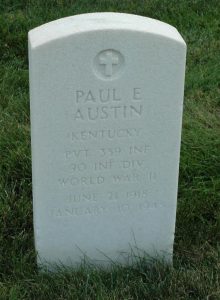
Austin, Paul E.
Army Private

Paul E. Austin, age 26, from Kentucky, Barren county.

Service era: World War II
Military history: 359th Infantry, 90th Infantry Division

Date of death: Wednesday, January 10, 1945
Death details: Killed in action
Cemetery: Zachary Taylor National

Source: National Archives, grave marker

Simmons, Omer J.
Army Private 1st class

Omer J. Simmons, age 23, from Barren County Kentucky.

Service era: World War II

Date of death: Sunday, January 3, 1943
Death details: In November 1942, the U.S. Army’s 32nd Infantry Division regained control of Buna, Papua New Guinea, with its goal of neutralizing an enemy threat to Port Moresby and, ultimately, to the Australian mainland itself. The rugged terrain that the soldiers faced was fiercely defended by Japanese troops and included tidal swamplands with a labyrinth of camouflaged trenches and bunkers. In December 1942, when the 32nd Infantry Division was reinforced with Australian soldiers, Buna finally fell to the Allies; however, malaria and other tropical diseases contributed to a high number of casualties and deaths for the 32nd Infantry Division. Private First Class Omer J. Simmons entered the U.S. Army from Kentucky and served in Company G, 126th Infantry Regiment, 32nd Infantry Division. On January 3, 1943, Japanese forces attacked an Allied position in the village of Tara Kina, forcing Company G to retreat. Following the withdrawal, PFC Simmons was discovered to be missing, and is presumed to have drowned while his unit was crossing a deep river as part of the retreat. He was not seen again, and his remains could not be recovered following the war. Today, Private First Class Simmons is memorialized on the Walls of the Missing at the Manila American Cemetery in the Philippines.

Source: National Archives, Defense POW/MIA Accounting Agency, Daily News (1943)

Barlow, Woods Richardson
Navy Seaman 1st class

Woods Richardson Barlow, age 20, from Cave City, Kentucky, Barren county.

Parents: William H. Barlow

Service era: World War II

Date of death: Saturday, December 26, 1942
Death details: Following the Allied surrender on the Bataan Peninsula on April 9, 1942, the Japanese began the forcible transfer of American and Filipino prisoners of war to various prison camps in central Luzon, at the northern end of the Philippines. The largest of these camps was the notorious Cabanatuan Prison Camp. At its peak, Cabanatuan held approximately 8,000 American and Filipino prisoners of war that were captured during and after the Fall of Bataan. Camp overcrowding worsened with the arrival of Allied prisoners who had surrendered from Corregidor on May 6, 1942. Conditions at the camp were poor and food and water supplied extremely limited, leading to widespread malnutrition and outbreaks of malaria and dysentery. By the time the camp was liberated in early 1945, approximately 2,800 Americans had died at Cabanatuan. Prisoners were forced to bury the dead in makeshift communal graves often completed without records or markers. As a result, identifying and recovering remains interred at Cabanatuan was difficult in the years after the war. Seaman First Class Woods Richardson Barlow, who joined the U.S. Navy from Kentucky, served aboard the USS Canopus (AS-9) in the Philippines during World War II. He was captured on Corregidor Island following the Allied surrender and was interned at the Cabanatuan Prison Camp, where he died of beriberi on December 26, 1942. Seaman First Class Barlow was buried in a communal grave in the camp cemetery along with other deceased American POWs; however, his remains could not be associated with any remains recovered from Cabanatuan after the war. Today, Seaman First Class Barlow is memorialized on the Walls of the Missing at the Manila American Cemetery in the Philippines.
Cemetery: Tablets of the Missing at Manila American

Source: National Archives, American Battle Monuments Commission, Defense POW/MIA Accounting Agency

Back To Top