Skip to content

Smith, Jimmy Joe
Army Specialist 4
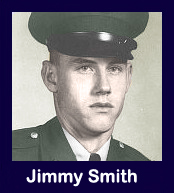
Jimmy Joe Smith, age 20, from Cane Hill, Arkansas, Washington county.

Service era: Vietnam
Military history: Bronze Star citation: For meritorious service in connection with military operations against an armed hostile force in the Republic of Vietnam. Specialist Four Smith distinguished himself while serving as a Team Leader in the Reconnaissance Platoon of the 2/35th Infantry. Specialist Four Smith’s fire team participated in long range reconnaissance patrols reporting the location and disposition of enemy forces. His vast knowledge of infantry weapons and his ability to navigate over extremely dense jungles under hazardous conditions insured the success of each mission he was assigned. His industriousness, diligence, and pride in his work enabled all members of his team to provide only the highest level of accomplishments. His sincere respect for authority and for his fellow man gained him the admiration of his superiors and subordinates alike. While attempting to aid a fellow comrade, Specialist Four Smith was fatally injured in a helicopter accident on 4 April 1967. His ultimate sacrifice in the service of his country, coupled with his praiseworthy record of outstanding accomplishments, parallel the highest traditions of the military service and reflect great credit upon himself, his unit, and the United States Army.
, 35th Infantry Regiment

Date of death: Tuesday, April 4, 1967
Death details: Died in helicopter accident, Binh Dinh Province

Source: National Archives, 35th Infantry Regiment Association

Estes, Edward Eugene
Army Private 1st class

Edward Eugene Estes from Washington County Cane Hill, Arkansas .

Parents: Mary Estes

Service era: Korea

Date of death: Unknown
Death details: In early July 1950, the U.S. Army’s 34th Infantry Regiment was occupying defensive positions just above the village of P’yongt’aek, South Korea, when it came under attack by the North Korean People’s Army (NKPA) 4th Division. The 34th Infantry had previously been on garrison duty in Japan and were not yet back up to combat strength. The NKPA attack was led by tanks; vastly outnumbered and lacking effective anti-tank weapons, the 34th Infantry was completely overwhelmed. They were forced to move south to Ch’onan where hasty defensive positions were established along two roads leading further south. However, the NKPA continued its relentless attack and again pushed the 34th Infantry out of their fighting positions, driving them down the Osan-Ch’onan road. After another brief but sharp battle on the morning of July 8, the Americans began a general withdrawal south to the Kum River Line, where U.S. forces would organize a defense in the hope of keeping the NKPA from reaching Taejon. During this series of fighting withdrawals, many U.S. soldiers were killed or captured by the enemy. Corporal Edward Eugene Estes entered the U.S. Army from Arkansas and was a member of A Company, 1st Battalion, 34th Infantry Regiment, 24th Infantry Division. He was captured during the fighting withdrawal and was marched with other prisoners toward the Apex prison camps in North Korea. He was greatly weakened during the march and died of illness in February 1951. His remains were not identified among those returned to the U.S. following the ceasefire, and he is still unaccounted for. Today, Corporal Estes is memorialized on the Courts of the Missing at the National Memorial Cemetery of the Pacific. His name is also inscribed on the Korean War Veterans Memorial Wall in Washington, DC, which was updated in 2022 to include the names of the fallen.

Source: National Archives, Defense POW/MIA Accounting Agency, The Sun (1953)

Back To Top