Skip to content

Roecker, Matthew
Army Private 1st class

Matthew Roecker, age 18, from Poland, Indiana, Clay county.

Parents: Greg and Billie Jo (Pemberton) Roecker

Service era: Afghanistan
Schools: Cloverdale High
Military history: Indiana National Guard

Date of death: Sunday, January 17, 2021
Death details: Killed by a hit and run driver in Bloomington, Indiana, where he was depoloyed for COVID-19 relief
Cemetery: Little Mount Cemetery in Owen County

Source: Indiana Public Media, Chandler Funeral Homes 

Stultz, Gregory Scott
Marines Corporal

Gregory Scott Stultz, age 22, from Brazil, Indiana, Clay county.

Parents: Bill Stultz and Kim Stultz

Service era: Afghanistan
Schools: Northview High (2006), Rend Lake College
Military history: 3rd Reconnaissance Battalion, 3rd Marine Division, III Marine Expeditionary Force, Okinawa, Japan.

Date of death: Friday, February 19, 2010
Death details: Died in Helmand Province, Afghanistan from a gunshot wound to his stomach. He died during airlift to a hospital.
Cemetery: Summit Lawn

Source: Department of Defense, Brazil Times, WTWO, WTHR.

Rose, Gary Lee
Army Private 1st class

Gary Lee Rose, age 19, from Brazil, Indiana, Clay county.

Parents: Lester Rose

Service era: Vietnam

Date of death: Wednesday, July 29, 1970
Death details: Non-hostile, illness in South Vietnam
Cemetery: Summit Lawn

Source: National Archives, Terre Haute Tribune Star (1970)

Thompson, Charles M.
Army Specialst 3

Charles M. Thompson, age 22, from Clay County Carbon, Indiana .

Parents: Max and Helen Thompson
Spouse: Myla

Service era: Korea

Date of death: Thursday, August 11, 1955
Death details: Killed in the collision of two Flying Boxcar in Germany.

Source: Associated Press (1955), The Times (1955)

Neiswinger, Thomas William
Army Private 1st class

Thomas William Neiswinger, age 21, from Clay County Indiana.

Parents: Edward Neiswinger

Service era: Korea

Date of death: Wednesday, September 6, 1950
Death details:

On Sept. 25, 2025, the Defense POW/MIA Accounting Agency identified the remains of U.S. Army Cpl. Thomas William Neiswinger, missing from the Korean War.

Neiswinger entered the U.S. Army from Indiana and served with F Company, 2nd Battalion, 38th Infantry Regiment, 2nd Infantry Division. On Sept. 6 and 7, 1950, elements of Neiswinger’s 2nd Battalion launched attacks on a prominence called Hill 209 along the Naktong River in South Korea. After failing to secure the hill due to strong enemy resistance and in torrential rain, the U.S. troops pulled back, but not without suffering casualties. Neiswinger was among those reported missing in action on Sept. 6, 1950. Renewed efforts later brought the area under American control, but by that time, the heavy rains had been continuing for days, and the floodwaters from the Naktong River were sufficient to cover up any recent graves in the area, impeding efforts to recover the remains of fallen soldiers. In Sept. 1951, during post-war search and recovery efforts, members from the 565th Quartermaster Graves Registration Company recovered three sets of remains from a group burial near the village of An-Dong, South Korea. One of the sets of remains could not be associated with any unresolved casualty from the Korean War and was declared unidentifiable, and in 1956 was interred as a Korean War Unknown in the National Memorial Cemetery of the Pacific in Hawaii. In May 2021, as part of Phase 3 of the Korean War disinterment project, DPAA personnel accessioned this Unknown to the DPAA laboratory for analysis. There, based on the laboratory analysis and total circumstantial evidence, the remains were identified as those of Neiswinger.

Source: National Archives, Defense POW/MIA Accounting Agency, The Terre Haute Tribune (1950)

Fugate, Robert B.
Army 1st lieutenant

Robert B. Fugate, age 35, from Clay County Indiana.

Service era: World War II

Date of death: Sunday, January 28, 1945
Death details: On December 13, 1944, Japanese forces in the Philippines began the transfer of 1,621 Allied prisoners of war (POWs) to Japan. The POWs were to make the journey aboard transport ships whose harsh conditions and extreme overcrowding led survivors to refer to them as “Hell Ships.” The ships also lacked markings that would distinguish them from any other military target, causing some of them to be attacked by Allied forces who could not identify them as POW transports. On December 14, 1944, Allied aircraft attacked the first ship, the Oryoku Maru, in Subic Bay in the Philippines, killing many Allied POWs who became lost in the water, sank with the ship, or were washed ashore. Survivors of the bombing were put aboard two other ships, the Enoura Maru and the Brazil Maru, to continue on to Japan. During its journey on January 9, 1945, while anchored in Takao Harbor, Formosa (present-day Taiwan), the Enoura Maru was attacked by Allied aircraft from the USS Hornet (CV-8), killing Allied POWs who were lost in the water, on board the ship, or on the nearby shore. Survivors of the Enoura Maru bombing were loaded onto the Brazil Maru, and reached Japan on January 30, 1945. As a result of these incidents, Allied POWs were lost in the Philippines, at sea between the Philippines and Taiwan, while anchored in Taiwan, at sea between Taiwan and Japan, and in Japan. The attacks on these POW transports ultimately resulted in a series of death notifications from the Japanese government through the International Red Cross (IRC), and some casualties were given up to five different dates of death at various locations during the transfer. Witness accounts from surviving POWs offer detailed information for a handful of casualties, but the specific dates of loss and/or last-known locations for many of these POWs are based on the most recent reported date of death. First Lieutenant Robert B. Fugate, who entered the U.S. Army from Indiana, was serving with the 88th Field Artillery Regiment (Philippine Scout) in the Philippines during World War II. He was taken as a POW following the Japanese invasion and was interned in the islands until December 1944, when he was transferred to the Oryoku Maru for transport to Japan. Records indicate 1LT Fugate survived the attack on the Oryoku Maru but was wounded in the incident. He was eventually transferred to the Brazil Maru, where, on January 28, 1945, he died of his wounds and was buried at sea. However, these reports often involve information solely furnished by enemy governments, with some casualties given multiple dates of death. Future research may determine these reports were inaccurate. 1LT Fugate’s remains could not be identified following the war and he is still unaccounted-for. Today, First Lieutenant Fugate is memorialized on the Walls of the Missing at the Manila American Cemetery in the Philippines. Based on all information available, DPAA assessed the individual’s case to be in the analytical category of Non-recoverable.

Source: National Archives, Defense POW/MIA Accounting Agency

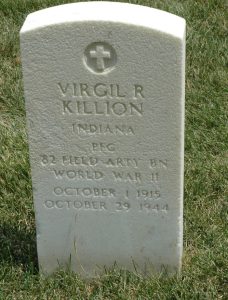
Killion, Virgil R.
Army Private 1st class

Virgil R. Killion, age 29, from Indiana, Clay county.

Service era: World War II
Military history: 82nd Field Artillery Battalion

Date of death: Sunday, October 29, 1944
Death details: Died of wounds
Cemetery: New Albany National

Source: National Archives, grave marker

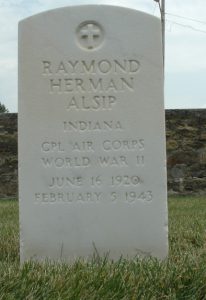
Alsip, Raymond Herman
Army Corporal

Raymond Herman Alsip from Indiana, Clay county.

Service era: World War II

Date of death: Friday, February 5, 1943
Death details: Killed in action
Cemetery: New Albany National

Source: National Archives, grave marker

McFee, Eugene Ambrose
Navy Machinist’s mate 3rd class

Eugene Ambrose McFee, age 21, from Clay County Brazil, Indiana .

Parents: Ada Strahl

Service era: World War II

Date of death: Sunday, March 1, 1942
Death details: Killed aboard the USS Houston when the ship was attacked traveling from Batavia to Java.

Source: National Arvhies, USSHouston.org, Indianapolis News (1943)

Back To Top