Skip to content

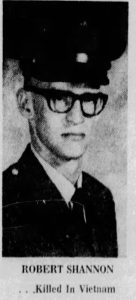
Shannon, Robert Joseph
Army Sergeant

Robert Joseph Shannon, age 20, from Clinton, Iowa, Clinton county.

Parents: Leonard Shannon

Service era: Vietnam
Schools: Clinton High (1963)

Date of death: Thursday, April 30, 1970
Death details: Hostile in South Vietnam

Source: National Archives, Quad City Times (1970)

Petersen, Dean Hass
Army Private

Dean Hass Petersen, age 20, from Iowa, Clinton county.

Service era: Korea
Military history: 35th Infantry Regiment

Date of death: Friday, September 7, 1951
Death details: 

On September 7, 1951, members of the 3rd Battalion, 35th Infantry Regiment, 25th Infantry Division, were positioned on Hill 682 and Hill 717, located south of Pyonggang, North Korea, in the “No Man’s Land” between the front lines of U.S. forces and the opposing Communist Chinese and North Koreans. After coming under heavy fire from Chinese and North Korean artillery, the 3rd Battalion was forced to fall back to Hill 717 to their west. Enemy action then pushed the 3rd Battalion to Hill 432, where the supporting batteries of the 64th Field Artillery were stationed. They were attacked again that night, but repulsed the enemy. On the morning of September 8, the 3rd Battalion launched a patrol to Hill 717 to search for the dead and missing, but enemy presence there stymied search efforts. During the patrol’s return to Hill 432, they encountered a small enemy force, and a firefight ensued until the enemy was dispersed. That night, Hill 432 came under yet another attack. Although the defensive perimeter was penetrated in several places, the enemy was ultimately repelled, and the perimeter re-established. After this fighting, the 3rd Battalion was relieved by the 2nd Battalion.

Private First Class Dean Hass Petersen, who joined the U.S. Army from Iowa, was a member of Company M, 3rd Battalion, 35th Infantry Regiment, 25th Infantry Division. He was reported missing in action on September 7, 1951, during the battle between Hill 682 and Hill 717, and was last seen near Chungdong-ni, North Korea, wounded by a grenade explosion. PFC Petersen was never reported to be a prisoner of war, and he has not been associated with any remains returned to U.S. custody after the ceasefire. He is still unaccounted-for. Today, Private First Class Petersen is memorialized on the Courts of the Missing at the National Memorial Cemetery of the Pacific.

Source: National Archives, 35th Infantry Regiment Association, Defense POW/MIA Accounting Agency
Keister, Richard Allison
Navy Radio Technician 3

Richard Allison Keister, age 19, from Clinton County Clinton, Iowa .

Service era: World War II
Schools: Lyons High (1943)

Date of death: Monday, August 6, 1945
Death details: Killed aboard USS Bullhead SS-332 when it was sunk by air attack near the Lombok Strait.

Source: On Eternal Patrol, Quad City Times (1945)

McKenna, Laurence P.
Army Technical sergeant

Laurence P. McKenna from Clinton County Clinton, Iowa .

Service era: World War II

Date of death: Saturday, August 7, 1943
Death details: Killed in an airplane crash in New Guinea. He was aboard C-47-DL “Eagle Beaver” when it crashed into Cleveland Bay about 20 minutes after takeoff.

Source: National Archives, Des Moines Register (1943)

Barber, William R.
Army Private

William R. Barber, age 22, from Clinton County DeWitt, Iowa .

Parents: Ethel W. Carlson

Service era: World War II

Date of death: Wednesday, December 16, 1942
Death details: Killed in action; missing in action or buried at sea
Cemetery: Tablets of the Missing at Manila American

Source: National Archives, American Battle Monuments Commission, Omaha World Herald (1943), Quad City Times (1943)

Webb, Francis E.
Army Private

Francis E. Webb, age 27, from Clinton County Clinton, Iowa .

Parents: Clinton Webb

Service era: World War II
Military history: 126 Infantry 32 Division

Date of death: Wednesday, December 2, 1942
Death details: In early 1942, the Japanese High Command began a campaign to take control of New Guinea and the Solomon Islands in an effort to cut off American and Australian naval routes and supply lines. From July through November, Allied forces solidified defenses to stop the Japanese advance, and from November 1942 to January 1943, attempted to capture the Solomon Islands. The Japanese had set up significant, almost impenetrable, defenses on the islands, concealed in areas of dense jungle, forcing Allied forces into separated and restricted columns of attack. As they approached Buna, the American and Australian troops faced a network of highly organized, mutually supporting bunkers fitted with reinforced walls, natural camouflage, and supplies. As a result of these difficulties, the first series of Allied attacks were defeated, demoralizing the troops and depleting their resources. It was not until December 2 that the Allies had any significant victories, and fighting in the area would continue until January 22, 1943. Fighting continued on the north coast of New Guinea into 1944, as Allied forces pushed the Japanese farther to the north and west. This campaign included retaking Japanese strongholds at Lae, Finschhafen, and Saidor. Private Francis E. Webb entered the U.S. Army from Iowa and served in Company L, 126th Infantry Regiment, 32nd Infantry Division. On December 2, 1942, Private Webb was killed in action during fighting on the Soputa-Sanananda Track, near Buna, New Guinea, but the exact circumstances of his loss are unknown. He has not been associated with any remains recovered from the area after the war and is still unaccounted-for. Today, Private Webb is memorialized on the Walls of the Missing at the Manila American Cemetery in the Philippines.

Source: National Archives, Defense POW/MIA Accounting Agency, Quad City Times (1943)

Finkboner, Wilbur
Army Private

Wilbur Finkboner from Iowa, Clinton county.

Service era: World War II

Date of death: Thursday, July 2, 1942
Death details: Following the Allied surrender on the Bataan Peninsula on April 9, 1942, the Japanese began the forcible transfer of American and Filipino prisoners of war to various prison camps in central Luzon, at the northern end of the Philippines. The largest of these camps was the notorious Cabanatuan Prison Camp. At its peak, Cabanatuan held approximately 8,000 American and Filipino prisoners of war that were captured during and after the Fall of Bataan. Camp overcrowding worsened with the arrival of Allied prisoners who had surrendered from Corregidor on May 6, 1942. Conditions at the camp were poor and food and water supplied extremely limited, leading to widespread malnutrition and outbreaks of malaria and dysentery. By the time the camp was liberated in early 1945, approximately 2,800 Americans had died at Cabanatuan. Prisoners were forced to bury the dead in makeshift communal graves often completed without records or markers. As a result, identifying and recovering remains interred at Cabanatuan was difficult in the years after the war. Private Wilbur Finkboner joined the U.S. Army Air Forces in Iowa and served with 28th Materials Squadron, 20th Air Base Group in the Philippines during World War II. He was captured on Corregidor Island following the American surrender and died of dysentery on July 2, 1942, at the Cabanatuan Prison Camp in Nueva Ecija Province. He was buried in a communal grave in the camp cemetery along with other deceased American POWs; however, his remains could not be associated with any remains recovered from Cabanatuan after the war. Today, Private Finkboner is memorialized on the Walls of the Missing at the Manila American Cemetery in the Philippines.

Source: National Archives, Defense POW/MIA Accounting Agency

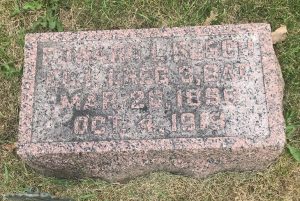
Busch, Edward L.
Army Private

Edward L. Busch, age 29, from Lost Nation, Iowa, Clinton county.

Service era: World War I

Date of death: Friday, October 4, 1918
Death details: Died of disease, Camp Pike, Arkansas
Cemetery: Lost Nation

Source: The State Historical Society of Iowa, Library & Archives Des Moines, grave marker

Back To Top