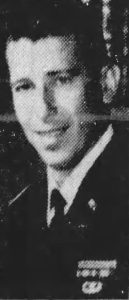
Alfred J. Facchiano, age 19, from Hammonton, New Jersey, Atlantic county.
Parents: Mary Urgo
Service era: World War II
Date of death: Saturday, November 20, 1943
Death details: From November 20 through 23, 1943, the U.S. Marine Corps and U.S. Navy conducted a large-scale amphibious assault on the Japanese-held atoll of Tarawa as part of Operation Galvanic, the Allied capture of the Gilbert Islands. Located 2,500 miles southwest of Hawaii, Tarawa was a crucial stepping stone in the planned U.S. offensive across the central Pacific toward Japan. The Japanese garrison on Tarawa’s main island of Betio was well-entrenched with hundreds of bunkers and gun positions behind formidable beach obstacles. The first wave of Marines approaching the shore encountered lower-than-expected tides, forcing them to leave their landing craft on the reef and wade the hundreds of yards to the beach under intense enemy fire. The heaviest number of U.S. casualties were suffered during this phase of the landing. Eventually, rising tides allowed U.S. warships to maneuver closer to shore and support the troops with effective naval gunfire. More Marines landed on the second day, launching attacks inland from the beaches and seizing the Japanese airfield on the island. However, the enemy launched vicious counterattacks and two more days of intense fighting were needed to secure Betio. The last enemy strongpoints were taken on the morning of November 23. The fighting on Betio cost the Marines nearly 3,000 casualties but enabled U.S. forces to press further across the Pacific and yielded valuable tactical lessons that reduced U.S. losses in future amphibious landings. Private First Class Alfred J. Facchiano entered the U.S. Marine Corps from Pennsylvania and served with Company M, 3rd Battalion, 2nd Marine Regiment, 2nd Marine Division. He was killed in action on 20 November 1943 during the Battle of Tarawa. Private First Class Facchiano was buried on Betio Island, but his remains could not be identified among those disinterred from the island following the war. Today, Private First Class Facchiano is memorialized on the Courts of the Missing at the National Memorial Cemetery of the Pacific.
Source: National Archives, Defense POW/MIA Accounting Agency