Skip to content

Ulbrich, Brian Scott
Army Specialist

Brian Scott Ulbrich, age 23, from Chapmanville, West Virginia, Logan county.

Service era: Iraq
Military history: L Troop, 3D Squadron, 3D Acr (Tf Baghdad), Fort Carson, Colorado

Date of death: Sunday, June 5, 2005
Death details: Hostile; Baghdad, Iraq

Source: Department of Defense, Military Times

Bowen, John Jr.
Army Sergeant 1st class

John Jr. Bowen from Holden, West Virginia, Logan county.

Spouse: Betty D. Bowen

Service era: Vietnam

Date of death: Monday, September 21, 1970
Death details: Non hostile death in Vietnam

Source: National Archives, UPI (1970)

Conn, Franklin L.
Army Private 1st class

Franklin L. Conn, age 23, from Logan County Kistler, West Virginia .

Parents: Minnie Cook, stepfather Altia Cook

Service era: Vietnam

Date of death: Friday, November 12, 1965

Source: National Archives, Beckley Post Herald (1965)

Collins, Clayton
Army Private 1st class

Clayton Collins, age 23, from Logan County Pecks Mill, West Virginia .

Spouse: Mary Ann
Children: Two children

Service era: Vietnam
Military history: He was drafted into the Army in June 1964, but declined to use his fatherhood status to avoid service.

Date of death: Friday, November 5, 1965
Death details: Killed in Vietnam when a personnel carrier he was in struck a land mine.

Source: National Archives, Roanoke Times (1965)

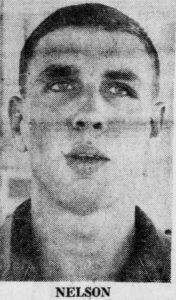
Nelson, Homer Douglas
Army Private 1st class

Homer Douglas Nelson, age 22, from Logan County Lake, West Virginia .

Parents: Focie Nelson

Service era: Vietnam
Military history: 25th Division

Date of death: Thursday, October 28, 1965
Death details: Killed in Vietnam when he was hit by enemy small arms fire while riding a helicopter making a reconnaissance mission for an emergency supply drop.

Source: National Archives, Honolulu Star Bulletin (1965)

Whitman, William Henry
Air Force Staff sergeant

William Henry Whitman from Man, West Virginia, Logan county.

Service era: Korea

Date of death: Wednesday, November 18, 1952
Death details: On November 18, 1952, a B-29 Superfortress (tail number 44-86392) with fourteen crew members departed Yokota Air Base, Japan, in a group of six medium bombers accompanied by fighter support aircraft. The briefed mission was a night bombing operation targeting the Sonchon supply depot in North Korea. After dropping its payload, the B-29 was illuminated by flares, cueing ground searchlights. The Superfortress was then lit up by multiple enemy searchlights, which highlighted it for nearby enemy MiG-15 fighters and during the ensuing attack that followed, both of the B-29’s inboard engines were disabled and a fire broke out in the right wing. The aircraft commander immediately turned the aircraft south toward the Bay of Korea’s island of Cho (Cho-do), which was under friendly control at the time. As the B-29 approached Cho-do, the flight engineer reported that the fire was quickly approaching the aircraft’s fuel tanks. Fearing an explosion, the aircraft commander ordered the flight crew to exit the aircraft. After the entire crew bailed out, the Superfortress crashed into the water just north of Cho-do. Of the fourteen on board, two survived. Rescue personnel later located the remains of two others, but ten crew members remain unaccounted-for.

Staff Sergeant William Henry Whitman, who entered the U.S. Air Force from West Virginia, served in the 345th Bombardment Squadron, 98th Bombardment Wing. He was the right gunner aboard this B-29 when it was shot down, and he was lost in the incident. No returning POWs mentioned having contact with SSgt Whitman, nor was he seen at any known holding point, interrogation center, hospital, or permanent POW camp. He remains unaccounted-for. Today, Staff Sergeant Whitman is memorialized on the Courts of the Missing at the National Memorial Cemetery of the Pacific.

Source: National Archives, Defense POW/MIA Accounting Agency

Lohr, Robert Franklin
Army Corporal

Robert Franklin Lohr, age 20, from West Virginia, Logan county.

Service era: Korea

Date of death: Sunday, December 3, 1950
Death details: On the evening of November 27, 1950, Chinese Communist Forces (CCF) launched a massive attack against the U.S. and United Nations (UN) troops stationed in the Chosin Reservoir area in north-east North Korea. The resulting seventeen-day conflict became known as the Battle of Chosin Reservoir. At the time of the initial CCF attack, members of the U.S. Army’s 31st and 32nd Infantry Regiments were defending the area north of Sinhung-ni, on the east side of the reservoir. The defenders were overwhelmed by the numerically superior CCF, and on December 1 were forced to withdraw to friendly lines at Hagaru-ri. Many men were lost or captured during the withdraw, with survivors reaching friendly lines in Hagaru-ri on December 2 and 3. Once at Hagaru-ri, the survivors of the withdrawal manned a section of the perimeter near East Hill, a strong defensive position overlooking the town. On the night of December 3, the Chinese attacked the Hagaru-ri perimeter and overwhelmed the defenders there. Many Americans were killed or went missing during these actions. Corporal Robert Franklin Lohr, who joined the U.S. Army from West Virginia, served with M Company, 3rd Battalion, 31st Infantry Regiment, 7th Infantry Division. He was killed in action near Hagaru-ri on December 3, 1950, as his unit, part of the 31st Regimental Combat Team, worked with American Marines to establish a defensive line around the town. His body could not be immediately recovered, and his remains were not identified among those returned to U.S. custody following the war. Today, Corporal Lohr is memorialized on the Courts of the Missing at the National Memorial Cemetery of the Pacific.

Source: National Archives, Defense POW/MIA Accounting Agency
Hensley, Eldred Jennings
Army Private 1st class

Eldred Jennings Hensley from Logan, West Virginia, Logan county.

Service era: Korea

Date of death: Tuesday, October 31, 1950
Death details: On July 5, 1950, Task Force Smith, the first U.S. ground element to engage North Korean People’s Army (NKPA) troops, was defending a position north of Osan, South Korea. The Task Force’s goal was to delay enemy forces by blocking their movement down the road south from Suwon to Taejon, which was a major avenue of advance for the NKPA. That morning, the Task Force was engaged by a column of enemy tanks. The anti-tank weapons that the infantrymen employed were ineffective, and a large number of tanks broke through their position. Task Force Smith was forced to withdraw to the south, suffering heavy casualties in the process. Corporal Eldred Jennings Hensley, who joined the U.S. Army from West Virginia, served with C Company, 1st Battalion, 21st Infantry Regiment, 24th Infantry Division. His unit was part of Task Force Smith, and he was captured by enemy forces on July 5. He was forced to march to a temporary prison camp near Manpo, North Korea. On October 31, Cpl Hensley was among a group of prisoners that began a march to the Apex prison camps on the Yalu River. Several days after leaving Manpo, Cpl Hensley collapsed, unable to continue the march. He was shot by a guard, and the group of prisoners was forced to march on. Corporal Hensley’s remains have not been identified among those returned to U.S. custody. Today, Corporal Hensley is memorialized on the Courts of the Missing at the National Memorial Cemetery of the Pacific.

Source: National Archives, Defense POW/MIA Accounting Agency
Back To Top