Skip to content

Gritz, Toby Richard
Marines 1st lieutenant

Toby Richard Gritz, age 25, from Santa Barbara, California, Santa Barbara county.

Spouse: Tanya A. Gritz

Service era: Vietnam

Date of death: Wednesday, March 25, 1970
Death details: Body recovered

Source: National Archives, The Signal (1970), Fort Worth Star Telegram (1970)

Cordero, William Edward
Air Force Major

William Edward Cordero, age 30, from Santa Barbara County Santa Barbara, California .

Spouse: Kathleen
Children: William Edward, 6; Theresa Eileen, 5; Anthony Paul, 4; Richard Carroll, 2

Service era: Vietnam
Schools: Santa Barbara High, Loyola University in Los Angeles graduate

Date of death: Tuesday, June 22, 1965
Death details: Died while missing in Vietnam

Source: National Archives, Santa Barbara News Press (1965)

Uribe, Joe Donald
Army Private

Joe Donald Uribe, age 19, from Santa Barbara, California, Santa Barbara county.

Parents: Margarite O. Uribe

Service era: Korea

Date of death: Thursday, November 2, 1950
Death details: During the last week of October 1950, Republic of Korea (ROK) Army forces under the control of the U.S. Eighth Army were advancing deep in North Korean territory, approaching the Yalu River on the Chinese-Korean border. Chinese Communist Forces (CCF) struck back in a surprise attack, engaging the ROK 1st and 6th Divisions near Unsan, some sixty miles north of Pyongyang. The U.S. 1st Cavalry Division, with the 8th Cavalry Regiment in the lead, was rushed forward to reinforce the ROK units in the Unsan area. On November 1, the regiment’s 1st Battalion took up positions north of Unsan, while the 2nd Battalion moved to guard the Nammyon River valley west of town, and the 3rd Battalion was placed in reserve at the valley’s southern end. Private First Class Joe Donald Uribe joined the U.S. Army from California and served in the Medical Company of the 8th Cavalry Regiment, 1st Cavalry Division. On November 2, 1950, he and other members of the Medical Company were supporting 8th Cavalry Regiment elements near Unsan when they received orders to withdraw. During this moving battle, PFC Uribe went missing, though circumstances surrounding his loss are unknown. He was not reported as a prisoner of war nor have his remains been recovered or returned to the U.S. since the ceasefire. Today, Private First Class Uribe is memorialized on the Courts of the Missing at the National Memorial Cemetery of the Pacific.

Source: National Archives, Santa Maria Times (1954)

Blake, Glenn Edward
Navy Reserves Machinist’s Mate 3rd class

Glenn Edward Blake from Santa Barbara. County Santa Barbara, California .

Spouse: Dorothy Blake

Service era: World War II

Date of death: Wednesday, October 25, 1944
Death details: Killed in the sinking of the USS Gambier Bay during the Battle of Leyte.
Cemetery: Manila American Cemetery

Source: National Archives, American Battle Monuments Commission

Shealy, Bernard Elmer
Marines Reserves Warrant officer

Bernard Elmer Shealy, age 25, from Santa Barbara, California, Santa Barbara. county.

Service era: World War II

Date of death: Saturday, November 20, 1943
Death details: From November 20 through 23, 1943, the U.S. Marine Corps and U.S. Navy conducted a large-scale amphibious assault on the Japanese-held atoll of Tarawa as part of Operation Galvanic, the Allied capture of the Gilbert Islands. Located 2,500 miles southwest of Hawaii, Tarawa was a crucial stepping stone in the planned U.S. offensive across the central Pacific toward Japan. The Japanese garrison on Tarawa’s main island of Betio was well-entrenched with hundreds of bunkers and gun positions behind formidable beach obstacles. The first wave of Marines approaching the shore encountered lower-than-expected tides, forcing them to leave their landing craft on the reef and wade the hundreds of yards to the beach under intense enemy fire. The heaviest number of U.S. casualties were suffered during this phase of the landing. Eventually, rising tides allowed U.S. warships to maneuver closer to shore and support the troops with effective naval gunfire. More Marines landed on the second day, launching attacks inland from the beaches and seizing the Japanese airfield on the island. However, the enemy launched vicious counterattacks and two more days of intense fighting were needed to secure Betio. The last enemy strongpoints were taken on the morning of November 23. The fighting on Betio cost the Marines nearly 3,000 casualties but enabled U.S. forces to press further across the Pacific and yielded valuable tactical lessons that reduced U.S. losses in future amphibious landings. Warrant Officer Bernard Elmer Shealy entered the U.S. Marine Corps from South Carolina and served in the Headquarters & Service Company of the 2nd Amphibious Tractor Battalion, 2nd Marine Division. He was killed in action on November 20 during the Battle of Tarawa. He was buried in Main Marine Cemetery, Cemetery #33, Grave #1, Row #2, Plot #8 on Betio, but after the war his remains were not identified among those disinterred from Betio. Today, Warrant Officer Shealy is memorialized on the Courts of the Missing at the National Memorial Cemetery of the Pacific.

Source: National Archives, Defense POW/MIA Accounting Agency

Dinnocenzo, Warren
Navy Reserves Apprentice Seaman

Warren Dinnocenzo, age 23, from Santa Barbara. County Santa Barbara, California .

Parents: Mr. Pasquale Dinnocenzo

Service era: World War II

Date of death: Thursday, October 15, 1942
Death details: On October 15, 1942, he was in a U.S. convoy of six ships that was towing barges loaded with urgently needed supplies toward Guadalcanal. The American forces on that island were in dire need of resupply. When the convoy was spotted by enemy aircraft, all but two ships withdrew from the area. The two ships that pressed on were the USS Meredith (DD-434,) a destroyer, and the USS Vireo (AM-54,) a lightly armed towing vessel. Upon receiving word that Japanese surface warships were operating in the area, both ships were forced to turn back from their mission. Because of its age and slow speed, Vireo was abandoned, and the crew taken aboard the Meredith. Within minutes, the Meredith was attacked by a large force of enemy aircraft. The destroyer sustained multiple bomb and torpedo hits and quickly sank. The survivors spent three days at sea before being rescued. The majority of the crews of both ships was killed in the incident.

Source: National Archives, Defense POW/MIA Accounting Agency, Santa Barbara News Press (1943)

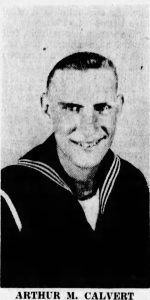
Calvert, Arthur Madison
Navy Seaman 2nd class

Arthur Madison Calvert, age 18, from Santa Barbara. County Santa Barbara, California .

Parents: Ferol Calvert

Service era: World War II

Date of death: Sunday, March 1, 1942
Death details: Killed aboard the USS Houston when the ship was attacked traveling from Batavia to Java.
Cemetery: Manila American Cemetery

Source: National Archives, American Battle Monuments Commission, USSHouston.org, Santa Barbara News Press (1942)

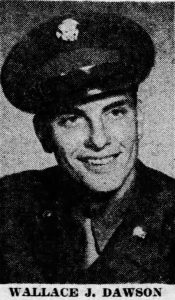
Dawson, Wallace James
Army Corporal

Wallace James Dawson from Santa Barbara County Santa Barbara, California .

Parents: Millard A. Dawson

Service era: Korea

Date of death: Unknown
Death details: On March 7, 2015, the Defense POW/MIA Accounting Agency (DPAA) identified the remains of Sergeant Wallace James Dawson, missing from the Korean War. Sergeant Dawson, who entered the U.S. Army from California, served with L Company, 3rd Battalion, 9th Infantry Regiment, 2nd Infantry Division. On February 14, 1951, his unit was occupying a defensive position near Sangsok, South Korea, when it was overrun by Chinese Communist Forces. SGT Dawson was captured during this action and taken to Changsong POW Camp 1 in North Korea, where he died of malnutrition in June 1951 and was buried near the camp. Following the war, as part of Operation Glory, SGT Dawson’s remains were repatriated to the U.S. but they were not able to be identified and were buried as unknowns at the National Memorial Cemetery of the Pacific, Hawaii. In 2014, advances in forensic technology prompted the disinterment and eventual identification SGT Dawson from these remains. Sergeant Dawson is memorialized on the Courts of the Missing at the National Memorial Cemetery of the Pacific. His name is also inscribed on the Korean War Veterans Memorial Wall in Washington, DC, which was updated in 2022 to include the names of the fallen.

Source: National Archives, Defense POW/MIA Accounting Agency, Santa Barbara News Press (1954)

Back To Top