Skip to content

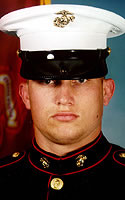
Parkerson, Harvey Emmett III
Marines Sergeant

Harvey Emmett III Parkerson, age 27, from Yuba City, California, Sutter county.

Service era: Iraq
Military history: B Co, Blt 1/4, 11Th Meu (Soc), Camp Pendleton, Ca

Date of death: Wednesday, August 18, 2004
Death details: Hostile; Najaf, Iraq

Source: Department of Defense, Military Times

Ryan, Frank D. Jr..
Air Force Sergeant

Frank D. Jr.. Ryan, age 41, from Yuba City, California, Sutter county.

Parents: Frank D. Ryan Sr.
Spouse: Married
Children: Daughter

Service era: Vietnam

Date of death: Friday, April 10, 1970
Death details: Killed when an RF4 Reconnaissance jet crashed into the air base at Udorn, Thailand.

Source: National Archives, AFTN VFW Memorial Post 10249, Sacramento Bee (1970)

Onstott, Howard Leander
Army Corporal

Howard Leander Onstott, age 31, from Sutter County Yuba City, California .

Parents: Alvin L. Onstott

Service era: Korea

Date of death: Tuesday, July 25, 1950
Death details: By July 1950, the North Korean People’s Army (NKPA) had taken control of Taejon, and the U.S. Eighth Army’s 25th Infantry Division and 1st Cavalry Division were sent into action. The 1st Cavalry Division deployed at Pohang between July 18-21 and immediately advanced west on the Taegu-Taejon road to establish blocking positions at Yongdong and defend the city. The ensuing three-day Battle of Yongdong was intense, and the 1st Cavalry Division was ultimately forced to withdraw on July 25 after the 5th Cavalry Regiment alone had lost 275 men. The battle inflicted heavy casualties on the NKPA and delayed its advance enough to allow United Nations (UN) forces to establish the Pusan Perimeter, but the NKPA still managed to capture many American prisoners of war (POWs). Prisoners were marched north to Seoul before being transferred to camps in Pyongyang. Many POWs were eventually rescued, though many others died from exhaustion and mistreatment. Poor record keeping by the NKPA and strained diplomatic tensions following the war have complicated the identification and recovery of those who went missing during the Battle of Yongdong, and many are still unaccounted for. Sergeant Howard Leander Onstott entered the U.S. Army from California and served in A Company of the 1st Battalion, 5th Cavalry Regiment, 1st Cavalry Division. On the morning of July 25, 1950, SGT Onstott was involved in a withdrawal from areas south of Yongdong that had been cut off from American positions in the city. A Company did manage to reunite with the rest of the 5th Cavalry Regiment; however, SGT Onstott went missing at some point during the action. After the war, a surviving POW reported that he had seen SGT Onstott in enemy captivity north of Pyongyang in late October 1950, though he also noted that SGT Onstott was in very bad shape and unable to walk. North Korean guards killed most of the POWs who were in SGT Onstott’s group, and though two mass graves were located, SGT Onstott’s remains could not be identified among those disinterred from the graves following the war. Today, Sergeant Onstott is memorialized on the Courts of the Missing at the National Memorial Cemetery of the Pacific. His name is also inscribed on the Korean War Veterans Memorial Wall in Washington, DC, which was updated in 2022 to include the names of the fallen.

Source: National Archives, Defense POW/MIA Accounting Agency, Sacramento Union (1954)

Smith, Elza R.
Army Staff sergeant

Elza R. Smith from Sutter County California.

Service era: World War II

Date of death: Monday, January 22, 1945
Death details: On December 13, 1944, Japanese forces in the Philippines began the transfer of 1,621 Allied prisoners of war (POWs) to Japan. The POWs were to make the journey aboard transport ships whose harsh conditions and extreme overcrowding led survivors to refer to them as “Hell Ships.” The ships also lacked markings that would distinguish them from any other military target, causing some of them to be attacked by Allied forces who could not identify them as POW transports. On December 14, 1944, Allied aircraft attacked the first ship, the Oryoku Maru, in Subic Bay in the Philippines, killing many Allied POWs who became lost in the water, sank with the ship, or were washed ashore. Survivors of the bombing were put aboard two other ships, the Enoura Maru and the Brazil Maru, to continue on to Japan. During its journey on January 9, 1945, while anchored in Takao Harbor, Formosa (present-day Taiwan), the Enoura Maru was attacked by Allied aircraft from the USS Hornet (CV-8), killing Allied POWs who were lost in the water, on board the ship, or on the nearby shore. Survivors of the Enoura Maru bombing were loaded onto the Brazil Maru, and reached Japan on January 30, 1945. As a result of these incidents, Allied POWs were lost in the Philippines, at sea between the Philippines and Taiwan, while anchored in Taiwan, at sea between Taiwan and Japan, and in Japan. The attacks on these POW transports ultimately resulted in a series of death notifications from the Japanese government through the International Red Cross (IRC), and some casualties were given up to five different dates of death at various locations during the transfer. Witness accounts from surviving POWs offer detailed information for a handful of casualties, but the specific dates of loss and/or last-known locations for many of these POWs are based on the most recent reported date of death. Technical Sergeant Elza R. Smith joined the U.S. Army from Illinois and served in the Headquarters Battery, 59th Coast Artillery Regiment during the defense of the Philippines. He was stationed at Fort Mills on the island of Corregidor, where American forces made their last stand in the Philippines, and was taken as a POW following the Japanese invasion. TSgt Smith was interned in the islands until December 1944, when he was transferred to the Oryoku Maru for transport to Japan. Records indicate that TSgt Smith survived the sinking of the Oryoku Maru and was eventually transferred to the Brazil Maru. He died on January 22nd, 1945, from wounds received during the previous attacks. However, these reports often involve information furnished by enemy governments, with some casualties given multiple dates of death. Future research may determine these reports were inaccurate. TSgt Smith’s remains could not be identified following the war and he is still unaccounted-for. Today, Technical Sergeant Smith is memorialized on the Walls of the Missing at the Manila American Cemetery in the Philippines. Based on all information available, DPAA assessed the individual’s case to be in the analytical category of Non-recoverable.

Source: National Archives, Defense POW/MIA Accounting Agency, Sacramento Union (1946), Lawrence County News (1945)
Back To Top