Skip to content

Severson, Robert Daryl
Army Specialist 4

Robert Daryl Severson, age 20, from Silver Springs, New York, Wyoming county.

Parents: Ava Cummings

Service era: Vietnam
Schools: Letchworth Central (1970)
Military history: 23rd Infantry Division

Date of death: Thursday, August 5, 1971
Death details: Killed in action in Vietnam when his tank hit a land mine.
Cemetery: Maple Grove at Gainesville

Source: National Archives, Rochester Democrat and Chronicle (1971)

Moden, Richard Sheldon
Army Specialist 4

Richard Sheldon Moden, age 20, from Bliss, New York, Wyoming county.

Parents: Sheldon J. Moden

Service era: Vietnam

Date of death: Tuesday, May 5, 1970
Death details: Hostile, died missing, Cambodia. Helicopter crash.

Source: National Archives, Rochester Democrat and Chronicle (1970), Associated Press (1970)

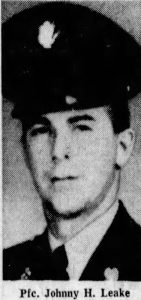
Leake, Johnny H.
Army Private 1st class

Johnny H. Leake, age 22, from Wyoming County Wyoming, New York .

Service era: Vietnam

Date of death: Sunday, January 2, 1966
Death details: Hostile, South Vietnam
Cemetery: Arlington National

Source: National Archives, Buffalo News (1966)

Schwab, Edward Anthony
Air Force Airman 1st Class

Edward Anthony Schwab, age 20, from Java, New York, Wyoming county.

Parents: John E. Schwab

Service era: Korea

Date of death: Thursday, January 29, 1953
Death details: On the evening on January 28, 1953, a B-29 Superfortress (tail number 42-65357A) with a crew of fourteen departed Kadena Air Base in a flight of four. The briefed mission was a night bombing operation targeting the Kompo-Dong supply yard south of Pyongyang, North Korea. Shortly after releasing its payload, the B-29 was attacked by enemy MiG-15 fighters. Just after midnight, the aircraft commander made a distress call and ordered the crew to bail out. A few minutes later, witnesses reported the Superfortress caught fire and exploded in midair near Hungsu-ri. It is believed that five airmen were still aboard the aircraft when it exploded. The nine surviving crew members were captured by the North Koreans; three of them were returned to U.S. custody following the war, and one is known to have died at the Pike’s Peak prisoner interrogation center. While being moved in a convoy to a holding site, the remaining five prisoners were “liberated” by a group of Korean irregulars, believed to be North Koreans masquerading as South Korean guerrillas. Later that day, the B-29’s Aircraft Commander (Captain Gilbert Ashley) was allowed to contact United Nations Forces. On April 24, U.S. forces attempted to rescue the five men, but the rescue aircraft was fired upon during the attempt and the efforts were abandoned. Later reporting revealed the loyalty of the guerrilla unit and the probability that it had used the prisoners as bait. The five prisoners became known as the “Ashley 5,” after the Aircraft Commander, and all five of them remain unaccounted-for, along with the five who were believed to be aboard the plane when it exploded and the one who died at the Pike’s Peak center. Airman Second Class Edward Anthony Schwab, who joined the U.S. Air Force from New York, was assigned to the 28th Bombardment Squadron, 19th Bombardment Squadron. He was the radio operator aboard this B-29 when it went down, and was not among the known survivors of this loss. Additionally, no returning POWs mentioned contact with A2C Schwab, nor was he seen at any known holding point, interrogation center, hospital, or permanent POW camp. He remains unaccounted-for. Today, Airman Second Class Schwab is memorialized on the Courts of the Missing at the National Memorial Cemetery of the Pacific. Relativeswerelatertoldthoseaboardsurvivedthecrashandwereheldcaptivebytheenemy.

Source: National Archives, Defense POW/MIA Accounting Agency, Buffalo News (1953)
Boatfield, Robert J.
Army Private

Robert J. Boatfield, age 22, from New York, Wyoming county.

Service era: World War II

Date of death: Wednesday, August 12, 1942
Death details: Following the Allied surrender on the Bataan Peninsula on April 9, 1942, the Japanese began the forcible transfer of American and Filipino prisoners of war to various prison camps in central Luzon, at the northern end of the Philippines. The largest of these camps was the notorious Cabanatuan Prison Camp. At its peak, Cabanatuan held approximately 8,000 American and Filipino prisoners of war that were captured during and after the Fall of Bataan. Camp overcrowding worsened with the arrival of Allied prisoners who had surrendered from Corregidor on May 6, 1942. Conditions at the camp were poor and food and water supplied extremely limited, leading to widespread malnutrition and outbreaks of malaria and dysentery. By the time the camp was liberated in early 1945, approximately 2,800 Americans had died at Cabanatuan. Prisoners were forced to bury the dead in makeshift communal graves often completed without records or markers. As a result, identifying and recovering remains interred at Cabanatuan was difficult in the years after the war. Private Robert J. Boatfield entered the U.S. Army Air Forces from New York and served with the 19th Air Base Squadron, 20th Air Base Group in the Philippines during World War II. He was captured in Bataan following the American surrender on April 9, 1942, and died of malaria on August 12, 1942, at the Cabanatuan Prison Camp in Nueva Ecija Province. He was buried in a communal grave in the camp cemetery along with other deceased American POWs; however, his remains could not be associated with any remains recovered from Cabanatuan after the war. Today, Private Boatfield is memorialized on the Walls of the Missing at the Manila American Cemetery in the Philippines.
Cemetery: Manila American Cemetery

Source: National Archives, American Battle Monuments Commission, Defense POW/MIA Accounting Agency

Back To Top